Man Seeks (Straightforward) God

23 01 2012

Over the last decade or so, the conversation about God and religion in the public square has been dominated by the extremes.  Whether angry atheists convinced that religion “poisons everything” or defensive and dogmatic believers who condemn atheists in equally strong language, the impression often given is that there are two groups of fundamentally different people out there who can do little besides shout at each other across the huge and unbridgeable chasm between them.

But the picture sketched above does not tell the whole story.  In between these extremes exist more moderate atheists and believers, as well as a growing demographic of people referred to as the “nones”—a name derived from checking the “None” box on surveys asking for one’s religious preference.  Simply put, Nones aren’t sure about God and religion.  They’re not, by in large, atheists (93% claim to believe in God or a higher power), nor are they adherents of any particular religious tradition.  They’re searching, seeking, inquiring.  They’re open to God, but not in traditional forms and expressions.

Former NPR correspondent Eric Weiner speaks for the Nones in his new book Man Seeks God: My Flirtations with the Divine.  In a recent article, Weiner expresses his exasperation with the “true believers” and the “angry atheists” that have dominated (North) American religious discourse over the last decade or so.  Like many of us, Weiner sees the world as just a bit more grey than the black and whites offered by these two groups, and is open to a much wider range of questions and answers than they are.

According to Weiner, Nones

don’t get hung up on whether a religion is “true” or not, and instead subscribe to William James’s maxim that “truth is what works.” If a certain spiritual practice makes us better people—more loving, less angry—then it is necessarily good, and by extension “true.”

Nones are, apparently, characterized by an extremely pragmatic approach to issues of God and religion.  The fundamental question, according to Weiner, is not, “What is the good, the true, and the beautiful?” but “what works for me?”  Of course, there are numerous unstated assumptions about the nature of the good and beautiful embedded in Weiner’s assertion that if a spiritual practice makes us better people it is “true,” but this is, nonetheless, an undeniably human-centred approach to questions of God and religion.

A little later, Weiner makes this even clearer:

We need a Steve Jobs of religion. Someone (or ones) who can invent not a new religion but, rather, a new way of being religious. Like Mr. Jobs’s creations, this new way would be straightforward and unencumbered and absolutely intuitive. Most important, it would be highly interactive. I imagine a religious space that celebrates doubt, encourages experimentation and allows one to utter the word God without embarrassment. A religious operating system for the Nones among us. And for all of us.

“Straightforward,” “unencumbered,” and “absolutely intuitive.”  These are interesting adjectives to place alongside of the quest of faith, to be sure.  Historically, the pursuit of God has been one of great joy, self-discovery, and peace, to be sure, but also one of self-denial, struggle, and even periods of great doubt and suffering, as countless people of faith down through the ages would attest.  A prominent image of the path to God is one of ascent—an image evoking the long and arduous process of climbing a mountain.  There is exertion and pain and struggle on the path to the top.  Indeed, Jesus himself said that “Whoever wants to be my disciple must deny themselves and take up their cross daily and follow me” (Luke 9:23).  Evidently, faith isn’t supposed to always be easy.

We have just made our way through the Christmas season.  If the Christian story is to be believed, the light of the world entered the human predicament in a most unusual, unexpected, uncomfortable, and possibly even embarrassing manner.  Jesus’ arrival on the human scene did not nicely align itself with what human beings thought ought to be the case, with how they thought divinity ought to look, with the way in which they imagined a rescue operation ought to be undertaken. It still doesn’t, for many of us.  We have all quite likely imagined other, more “straightforward” ways for God to save than the way represented by the birth and career of Jesus.

But perhaps the truth isn’t always comfortable or unencumbered or straightforward or intuitive. Perhaps, in addition to our capacity to interrogate reality, the truth asks questions of us.  Perhaps it is we who must conform to what is real and true and good and beautiful, rather than adapting and adjusting these concepts and behaviours to fit our preferences.  Indeed, if truth really is something that exists outside and independent of human minds and hearts, then perhaps the first question to ask—for Nones and for all the rest of us—is not, “what works?” or “what seems to make the most sense to me?” or “what do I prefer?” but “what is true and how do I align myself with it?”

The Christian conviction is that the struggle of faith—with all of the wrestling and sorting through our embarrassment and confusion and discomfort as we align ourselves with what is true—is worth it.  And that the view from the summit of the mountain is spectacular.

Ryan Dueck


Rules… or Ruler…

11 01 2012

Rules. Rules. Rules.

One of the most common complaints about Christianity is that it is merely a pile of rules. These rules are sometimes ones about what you should do (ie, “read your Bible”), but more often are about what you shouldn’t do (“do not have sex… well, maybe a little after you get married… but don’t enjoy it…”). This criticism – which emerges out of many people’s experience – upsets us because these rules seem to be primarily there to exert power over people, and to steal away some of their fun.

Now, I could rail against this in a whole host of ways. Or I could also suggest that many of the rules that Christians live by are there to protect people from the un-fun consequences of a false kind of fun. And that would be true, at least for some of them. But I think there’s a better answer:

Christians don’t follow rules. They follow the One Who Rules.

Of course, I recognise that there are some – if not many – people claiming to be Christian, who most certainly do seem to follow rules. One option from that, then, is that those people are not really Christians. And, sometimes, I suggest they are not. But, sometimes (and I’d like to think most of the time) Christians are actually keeping the rules, not following them. That might seem like semantics, but it makes all the difference.

Following is a walking metaphor. It is about letting something determine where you go, letting it rule and direct you. That “something” that you’re following can be a person, or perhaps a goal. If you’re following a person – perhaps a king, or a master, or a teacher – they tell you (or show you) where you need to be going in order to follow them, and out of that emerge your “rules”. You then have two potential pitfalls: you could potentially forget about following the person, and just follow the rules in-and-of-themselves; or you could ignore the rules, as an expression of not being committed to following the person any more. But in either of these options, whether you follow the rules or you stop following them, the result is the same: you stop following the person.

Christians believe that Jesus is the King, the Master, the Teacher – and I might suggest they believe that for good reasons. And Jesus said, “Follow Me”, quite a lot. When asked what following Him would look like, Jesus boiled it down to two directions: “Love God. Love other people.” He also showed what following Him would look like, by loving God passionately, and loving people sacrificially. And then He said again, “Follow Me.” The specific examples that He either taught (ie, “don’t lie”) or did (ie, healing somebody), emerge out of loving God, and loving other people.

Jesus also emphatically criticised any people who claimed to be following God, but who were only interested in following the rules. That’s because most of the time, they were so busy following the rules that they had forgotten Who they were really meant to be following. They had forgotten Who so badly, that when He walked right up to them, and said, “Follow Me”, they didn’t even recognise Him.

Practically, what difference does this make today? Well, a good example is from World War II Germany. Those who just kept the rules and forgot Who they were following, said, “Jesus said not to lie, so when the Nazis ask us where the Jews are hiding, we have to tell them the truth.” The real followers said, “Jesus said following Him was about loving God and loving other people. So when a bunch of guys want to kill some people, we’ll lie to keep those people alive. Because letting them be killed is not loving them.” Most of the time, lying would not have been loving to God or others, and so they had kept that rule. But when it wasn’t loving to God or others, they saw the higher priority, which was following Jesus.

So Jesus isn’t asking you to follow a system, a belief, a mantra, or a set of rules. He’s saying the same thing He’s always said:

“Follow Me.”

Are you?

Matt Gray


Liberating Freedom

9 01 2012

Hey, gotta’ solution: why choose? To anyone surveying our current cultural scene, and its splintered breadth of options political, artistic, religious and social, an easy attitude rises from the pack: why choose a worldview to commit to – and all those hurdles called dedication and loyalty and sacrifice – when we can choose nothing, and live free of care? In societies as complex and fragmented as ours, it is a lot of work to survey every point of view out there. Why bother then? Why should I commit to a faith that will reduce my personal freedom, by telling me to live a certain way, and reduce my intellectual autonomy, by telling me to believe certain things?

Freedom from constraints. Sounds like a simple concept, right? Avoid serious commitments, and soar like an eagle, detached from the frenzied discussion below. This commitment-phobia is something many young folks today are committed to (!), according to leading sociologists. In a major survey of young adults today, for example, Notre Dame sociologist Christian Smith describes this as one of the major tenets of young lifestyles:

Numerous dimensions of the  culture of emerging adulthood – uncertainty about purpose, delaying settling down, the individual as authority, amorphous relationships, strategic management of risk, the tentativeness of cohabitation, aversion to moral judgments, reluctance to commit to social and political involvements and investments – reflect and reinforce their interest in maintaining as many live and promising options as is feasible. [i]

Yet, if I may beg to differ, I don’t think this kind of absolute freedom exists, or can ever exist. It is a myth. Every lifestyle will bind us and every conviction will restrain us, no exception. If one chooses to live his sexuality openly, for example, and change sexual partners as often as he pleases, he will enjoy the freedom to choose a new girl when the current one is not as appealing. But this very act will also constrain his freedom: this person will close itself to the pleasures of being committed to someone, and all the trust, serenity and shared memories of a lifelong relationship. In a similar way, someone may want to maximize her intellectual autonomy and believe that all truth is relative. But then her freedom will be restricted, because she won’t be able to believe in an infinite number of specific truths – be it evolution, Jesus’ resurrection, or karma – and won’t believe in something with all her heart.

Any choice, personal or intellectual, binds us. And not to choose binds us too, without giving us any real benefit. Absolute freedom is a myth; it does not exist. We will never be free from everything. The fish cannot swim outside of the water, or he dies. But inside the ocean, obeying the parameters he was created for, he is free to swim everywhere.

But what if we framed personal freedom differently? What if the question were, instead, not freedom from something, but freedom for something? What can truly capture my heart? What can I live for? What is the true life I can commit to? What is the most compelling worldview I can believe in?

And here comes the twist. Paradoxically, if we find the best choice, and believe the real truth, and really commit to it, we will find the freedom for which we were created. “You will know the truth, and the truth will set you free,” said Jesus.[ii] We will be free for life. Truth will bind us and therefore free us evermore. We will be free to be the persons we were created to be.

What do you live for then?

René Breuel


[i]     Christian Smith with Patricia Snell, Souls in Transition: The Religious & Spiritual Lives of Emerging Adults (New York and Oxford: Oxford University Press, 2009), 80.

[ii]    John 8:32


How Much Redemption?

7 12 2011

Let me start with a confession: I’m an unapologetic cat-lover. For several years two Norwegian forest cats (Sam and Luna) were part of our family. We deeply enjoyed their company, but this enjoyment always existed under something of a shadow: both had genetic heart conditions that led eventually to their premature death.

In the time since then, living without feline companionship, I’ve found myself reflecting on their “personhood,” if I may use this term. There are plenty of (in)famous accounts of animals that are reductive; among these Descartes suggested that they couldn’t feel pain. In contrast, I found that Sam and Luna each had unique personalities:  one cat was a morning “person,” the other wasn’t. They could be cheerful or cranky. They enjoyed play and humor and when we lost Luna, Sam visibly grieved her absence for his remaining months. Far from the machines that Descartes imagined animals to be, these two displayed an astonishing range of uniqueness.

I was recently reminded of a sermon by John Wesley when he reflects on the place of animals in the kingdom to come:

The whole brute creation will then, undoubtedly, be restored, not only to the vigour, strength, and swiftness which they had at their creation, but to a far higher degree of each than they ever enjoyed. They will be restored, not only to that measure of understanding which they had in paradise, but to a degree of it as much higher than that, as the understanding of an elephant is beyond that of a worm. And whatever affections they had in the garden of God, will be restored with vast increase; being exalted and refined in a manner which we ourselves are not now able to comprehend.[1]

Wesley isn’t alone in his conviction that God’s redemptive activity includes not only humans, but also a broad range of what he first created – George MacDonald and C.S. Lewis suggest similar things – and his sermon doesn’t arise out of mere sentimentality. John Wesley was, as Thomas Jay Oord puts it, “a theologian deeply interested in science,” who “kept abreast of the scientific developments of his day by reading the works of leading scientists and philosophers.” [2] Having beheld the intricate interrelation of all the various creatures in God’s creation, a new creation that consisted only of humans seemed unnecessary and nonsensical to Wesley; it would not account both the witness of the created order and that of Christian scripture. As Denis Edwards observes, there are a number of passages in the bible which include non-human creatures in the final state, including Revelation 5:13-14, which contains “a remarkable vision of all the creatures of Earth united in a great song of praise of the lamb, the symbol of the crucified and risen Christ.” [3]

I realise that my suggestion here opens up a huge variety of challenging questions. What about people who are allergic to cats, and who imagine heaven without them? Where would God possibly fit all the insects that have come and gone since the creation of the earth? Yet I think that the kingdom to come is better regarded as an object of hope and wonder than one which we can anticipate in too-concrete ways. I for one, look with hope not only to meet my grandpa again, but also to an expansive vision of the new creation, filled with lions, lambs and bugs alike.

Jeremy Kidwell

[1]  John Wesley, reflecting on Romans 8:19-22 and Isaiah 11:6 in his sermon, “The General Deliverence” – read the rest here: http://new.gbgm-umc.org/umhistory/wesley/sermons/60/)

[2] Thomas Jay Oord, Divine Grace and Emerging Creation, p. ix.

[3] Denis Edwards, Creaturely Theology, 81. Other instances include 1 Cor. 8:6, Rom 8:18-25, Col 1:15-20, Eph 1:9-23, Heb 1:2-3, 2 Peter 3:13, John 1:1-4, and Rev 21:1-22:13.


Black Friday Blues

2 12 2011

Black Friday—the traditional American shopping day that occurs the day after American Thanksgiving or the final Friday in November—has long been a tradition in the United States. For those who don’t know about it, it is the day that many retailers “go into the black” for the year, finally making a profit. Of course, because of the extensive sales (often beginning at 4am), many people have traditionally used this shopping day to begin purchasing gifts for Christmas. The final Friday in November has also, traditionally, marked the beginning of the Christmas season in North America. With the thanksgiving turkey eaten and all hints of Pilgrims, Native Americans, and other potentially disturbing history lessons happily buried beneath an evening of American football and a stomach ache from over-eating, the day-after-Thanksgiving used to greet those venturing into public with garlands, wreaths, bows, lights and Christmas carols buzzing in the air.

Not this year….

This year, the aforementioned Christmas accouterments began appearing sometime closer to November 15th or even November 1st. No one really seemed bothered by this remarkably early appearance of Christmas. However, some people were outraged when stores in America decided to start “Black Friday” sales on Thursday, adulterating a traditional public holiday both by making people work and by tainting the holiday with consumer practices (not that Thanksgiving wasn’t already well-consumerized, but the opening of retail stores on the holiday meant that the marketplace was more obviously and unavoidably infiltrating the day).

I, on the other hand, am deeply bothered by the early appearance of Christmas, not just this year but every year. Historically—as in before the Victorian invention of the modern celebration of Christmas—Christmas didn’t begin until the night of December 24th. At that time, the faithful marked the birth of Jesus and continued celebrating for 12 days. The celebration was, from what historians tell us, frequently marked by gift giving, lots and lots of drinking, eating, and general merry making. But I’m getting ahead of myself…

The period before Christmas is Advent, a much ignored season of the year in modern culture. Sure we have advent wreaths but there is no real sense of “advent,” from the Latin “adventus” or coming. Coming: as in not here yet…not arrived…expected…hoped for…looked for….

Some Christians—who initiated the celebration of Christmas in the first place—do try to keep the celebration of Advent alive. In Christian practice, Advent is kept alive through fasting, prayer, and a focus on the future, on things yet to come (not Christmas carols, lights, bows, wreaths, or garlands: these are the signs and symbols of celebration not expectation). What is it that Christians look for, long for, pray for, hope for during advent? Christians look for, hope for, expect the coming of Jesus. Advent is a time of remembering God’s promise to restore the world he created and of looking for the fulfillment of that promise. Christians believe that Jesus is that very creator-God come to dwell among humanity for a time, beginning that work of restoration and renewal. Yet that work isn’t finished yet. During Advent, as Christians re-live the historical hope for renewal, they also continue to hope for the completion of God’s work of restoration in a world still broken and still in need of healing.

So, what’s wrong with decking the halls early? Why is it worse than shopping on Thanksgiving? For the simple reason that in celebrating Christmas before the holiday comes, Christmas day and the celebration of Jesus’ birth becomes the end of the story, the main event that we then pack-up. By celebrating in advance, we lose the practice of hoping and of praying, we lose the holy expectation that sees our broken world and longs for it to be made whole.  In celebrating Christmas as the beginning of a new season—the Christmas season—Christians acknowledge that the process of God’s restoration begins with the coming of God in the person of Jesus but that restoration is not completed in a day. It is ongoing, continuing, even in this Advent season. So, I say, let’s not deck the halls with boughs of holy because it is not the season to be jolly… not yet. Right now, it is the season to be subdued by the darkness that engulfs our world and to long for God to come dwell among his people once again.

Jessica Hughes


A Beautiful Life

28 11 2011

What if I’m wrong?

Whatever space we happen to inhabit on the worldview continuum, this is a question that is bound to occur to all of us.  As human beings we simply do not and cannot know as much as we would like prior to deciding upon ultimate matters.  And I suspect that the “what if this is all a colossal mistake?” question occasionally occurs to even the most settled of minds.

At the end of Miroslav Volf’s Free of Charge there is a brief chapter entitled “Postlude: A Conversation with a Skeptic.”  After coming to agreement that the life of Jesus was good, beautiful, and worthy of emulation, Volf records the following hypothetical exchange around what would he do if he found out that the whole notion of a generous God who gives and forgives and who expects us to do the same, was nothing but an enormous lie:

Skeptic: “What if your dark thoughts at night—and my sober observations!—are true? What if you are waking up to a dream?”

Volf: “Well what?”

Skeptic: “You’d be wrong.”

Volf: “And I would have lived the right kind of life, the life you called beautiful.”

Skeptic: And have lived a false beautiful life! Wouldn’t that matter to you? Can a false life ever be good?”

Can a false life ever be beautiful? Can it be good?  And what, if anything, does our answer to this question have to say about the worldviews we adopt?

Some would suggest that our worldviews are simply the result of the culture we happen to have been raised in.  We are all socialized into and inhabit a particular “plausibility structure”—a taken-for-granted way of thinking about and living in the world which privileges certain kinds of answers to certain kinds of questions. At its most extreme, this view sets forth a kind of sociological determinism where our cognitive and behavioural options are completely determined by our social environment. Is it even possible to just accept a different way of looking at and living in the world given what we know about the nature of belief formation and the myriad sociological and psychological factors that contribute to the process?

Obviously it is.  People do, after all, change their minds about matters of faith.  But when they do, it seems that more often than not it is the quality of someone’s life that proves most compelling, as opposed to the comprehensiveness of their facts or the logical rigour of their argumentation. People respond to well-lived lives—to “beautiful” examples of forgiveness, grace, compassion, kindness, patience, and joy. The beauty and goodness of human lives can and do lead people to the conclusion that the foundation upon which such lives are based just might be true.

What is the connection between truth and beauty? However we answer this question, I think that the fact that we seem to be hard-wired to expect, even demand that the two be linked is suggestive. Is it possible that a genuinely good and beautiful life would have no connection to what is ultimately true about the world? If so, what would we be claiming about the nature of the world? About human beings? About God?

Sociologist Peter Berger has said that “to have faith is to bet on the ultimate validity of joy.” I think that it is also to bet on a deep and permanent connection between truth and beauty—between our deepest aspirations and intuitions and the way the world “really is” and will one day be.


Durable Legacy

7 11 2011

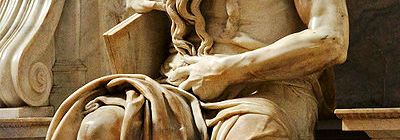
One afternoon in 1912, Sigmund Freud was enthralled by a statue. It captured his imagination for hours, and returning home from his trip to Rome, he poured himself over pictures and descriptions of that sculpture, analyzing its details and drawing sketches, until, after visiting it still other times, he wrote an essay interpreting it.

The statue was Michelangelo’s Moses, the marble masterpiece which Michelangelo regarded as his most life-like sculpture. Moses sits majestically, with intensity beaming from his face and flexing his muscles. The flow of Moses’ mantle and beard contrast to the robustness of his body, as Moses holds the tablets of the Ten Commandments, looking outraged to the idolatry of his people, who adore a golden calf just below Mount Sinai. The marble statue is so intriguing and realistic that there is even a story that Michelangelo struck Moses’ right knee and shouted, “now speak!”, as he saw it finished. There is actually a scar on the knee, thought to be a mark of Michelangelo’s hammer.

What is it that struck Freud so deeply about this statue? It could have been the skill of the artist, and his mastery of human anatomy and the human soul. It could have been the sculpture’s setting: the central piece of a grandiose tomb pre-ordered by Pope Julius II while he was still alive, anxious to align himself after a great spiritual leader. It could have been the character of Moses himself – the father of the Hebrew people, a looming giant in the arenas of history, law, and religion – or it could have been a combination of all these aspects.

Whatever diverse interests captured Freud attention, I imagine Michelangelo’s Moses got Freud thinking at least a bit about his own legacy. (Freud wrestled with Moses’ legacy throughout his life, and his very last book, written well into his eighties, is called Moses and Monotheism.) One of the greatest artists of history portrayed one of the great leaders of history to – Freud hoped – a great interpreter of the human psyche. Moses left behind a liberated people which, from a loose grouping of slave clans, became an unified nation, with an entrancing vision of the one true God, a legal system and self-identity that would last for millennia. Michelangelo, on the other hand, left behind exquisite pieces of artistry, to inspire, instruct and influence future generations. What would Freud leave behind? He was already a leading proponent of psychoanalysis, and was forging a new school of thought, but the question must have cross Freud’s mind: what would his final legacy be? Would it last like’s Moses’ people or Michelangelo’s art?

I guess no matter which talents move our hands, no matter which dreams transport our imaginations, the trio Moses-Michelangelo-Freud leaves us an eloquent joint legacy: ideas have consequences. What we believe matters. Moses is only remembered, and was only depicted by Michelangelo, and influential upon so many and upon Freud, because he holds stone tablets in his right hand, and looks with indignation to his left: because Moses believed in an omnipotent God, invisible but truer than a calf of gold. Moses’ convictions were fundamental for his vocation and the cornerstone of his legacy, as it is for everyone else. The durability of our legacy is sculpted with the concreteness of our beliefs.

René Breuel


Moments of Generosity and Gratitude

2 11 2011

The other day, a friend of mine began to tell me about an experience that had happened to him recently.

“I was walking to catch my bus from uni, along North Terrace, and I saw a homeless guy just standing on the corner. He was pretty old, and had a long white beard. But just before I’d passed him, I’d watched him make the sign of the cross – I don’t think he was making it to anybody in particular.”

“You don’t see that every day.” I said.

“No. So anyway, then I walked on. But as I was walking, I started to get this feeling. I got the sense that God, well, the Holy Spirit in me, wanted me to go back to the guy.”

This was pretty intriguing! I asked him what exactly he thought the Holy Spirit had wanted him to do.

“Well, it was kinda specific. The day was Monday, and my wife had given me some food – dry biscuits and some fruit-in-jars – for me to have for lunch throughout that week. I hadn’t got to my office yet, so they were still in my bag. I got the sense that God wanted me to go back to the guy and give him my food.”

“Wow. Okay. So did you go?” I asked.

“Well, there was more than that, actually…”

“Really?”

“Yup. I also got the sense that God wanted me to get a blessing from him.”

Now, that was surprising. Receiving blessings is not something people from our part of the Christian tradition would usually do.

“So, did you go?” I asked again.

“Not at first,” he said. “But then my wife rang, and she told me how she’d just picked up a bargain in Glenelg (a swanky seaside suburb here in Adelaide), and now she and my daughter were sitting on the beach, eating ice-cream.”

Now, I know my friend’s wife and kid – they’re hardly at Glenelg every day spending frivolously. I told him that he shouldn’t feel guilty.

“I know. I don’t think it was guilt. More gratitude. There was also a sense that if I did it, I’d be encountering something, um, special, sacred. So I turned around, and started walking to this guy. Every step I took, I was saying to myself, ‘You idiot, this is pointless!’ I was half-hoping that the guy had moved on. But he hadn’t.”

“So what happened when you met him?” I asked eagerly.

“Well,” my friend looked at me shyly, “I pulled out some of the biscuits and a jar of fruit…”

“Wait! Some of the biscuits, and one jar of fruit?” I asked.

“Er, yeah. I dunno, I just panicked. But when I handed them to him, you know what he said?”

“What?”

“He said to me, ‘Too Much!’. I, I was just astonished by that. I felt like it wasn’t enough. And I kinda felt like, his response was too much, for me. He was generous with his gratitude at my generosity. I didn’t deserve that. I suddenly felt grateful.”

“Wow. I can see that.” I said.

“And when I looked into his eyes as he said it, he was so happy. It made me see how God is so happy with the things we do for Him, even though they are so utterly inadequate. And how the happiness He feels at what we do is so gracious. The things we do are so minuscule, really. Yet He seems to say ‘Too much!’. I kinda saw Him saying that to me in the old man’s voice. It was  pretty humbling.”

            “Wow. So did you get a blessing?”

“That was funny.” My friend smiled. “I asked him for a blessing, and then he looked at me, and he said, ‘English, or Latin?’ I wasn’t expecting that! I’d thought he was some uneducated, crazy homeless guy. I stammered and told him that he could choose.”

“So what did he say?”

“He said, ‘In nomine Patris, et Filii, et Spiritus Sancti. Amen.’ Then I bowed my head, smiled, we patted each other on the shoulder, and I began to leave. Then he said, ‘The Lord be with you.’ I turned, a bit surprised, and said, ‘Er, and also with you.’ Then that was that.”

My friend then told me how he felt a burning in his chest for the rest of the day, and ruminated on that moment for many days since. And I was left thinking how generous, and sacred, some moments in life can be.

Matt Gray


Van Gogh’s Death: Post-Impressions

26 10 2011

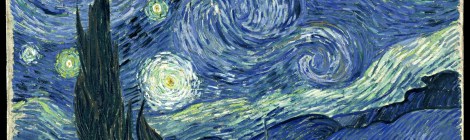
A new book about the famous Dutch artist Vincent van Gogh is taking the art world by storm. As seen this month on 60 Minutes, Pulitzer Prize- winning authors Steven Naifeh and Gregory White Smith have written a comprehensive 976-page biography of the Dutch painter whose works now sell for many millions of dollars.[1] Beyond the painstaking research and meticulous scholarship evident in their work, what’s most surprising and controversial about Van Gogh: The Life is its suggestion that van Gogh did not commit suicide as previously believed. Though this has been the view for the last 121 years, Naifeh and Smith argue that van Gogh died at the hands of two mischievous Parisian teenagers who, after spending much of their summer ridiculing the eccentric and life-wearied artist, acquired a revolver and misfired a bullet into his chest.

Of course, without a time machine, no one will ever really know how van Gogh died, but the facts about his life up until that fateful moment are well documented. He grew up interested in art and God, but his teachers and ministers shunned him for his unconventional habits. He had a love interest and desired fellowship with others, but he was rejected and had very few friends. A constant wanderer, deep thinker, and prolific letter writer, van Gogh also suffered from bouts of mental illness and sliced off part of his ear. His paintings reveal that he saw majestic beauty in nature as well as in ordinary people. But in the end, he died a relatively obscure, unappreciated artist wanting to ease the financial burdens of his brother Theo, who had been commissioning Vincent’s unsuccessful artwork for a good portion of his life.

For my own part in the Christian tradition, much of this bears striking resemblance to what happened to Jesus of Nazareth. Jesus too was rejected by the religious authorities of his day, alienated by close friends, and mocked by those who killed him. He had a deep appreciation for nature and craved committed personal relationships despite the betrayal and alienation he felt from some of his closest friends.

Of course, mysteries swirl around Jesus just as they now do for van Gogh, but note what their deaths have in common. On the cross, Jesus said, “Father, forgive them, for they do not know what they are doing.”[2] Here, at the height of his persecution and anguish, Jesus evidently was praying for others, hoping to ease their burdens, even as he lay dying for them. For van Gogh, it is reported that when asked by the police whether he shot himself, he strangely answered, “I believe so. Don’t accuse anybody else… It is I who wanted to kill myself.”[3] Are these the words of two suicidal maniacs, or do they reveal far nobler, more forgiving spirits than we ever realized? For Jesus and now for van Gogh, perhaps we ought to rethink our first impressions and form new, post-impressions.

Paul McClure


[2] Luke 23:34

[3] http://www.abs-cbnnews.com/lifestyle/10/19/11/new-book-says-van-goghs-death-was-killing-not-suicide


Don’t Take Your Religion So Seriously!

24 10 2011

A recent review of American Grace, a sociological study of religion in America, came to the conclusion that in an ethnically and ideologically diverse culture where religion is increasingly seen as a matter of personal preference as opposed to fixed identity, our survival as nations and citizens depends upon the following maxim: “Don’t take your religion too seriously.” Intense, sectarian devotion is dangerous and suspicious. Peace and harmony in the twenty-first century depend upon adopting a “bland is beautiful” approach to religion.

Better yet, why not just stop caring about religion at all? Canadian journalist Neil MacDonald coined the term “apatheism” to get at the idea that given the political reality in the USA (and Canada), apathy toward the divine is the best approach:

I have no religious beliefs.  None…. There’s a better word for what I am: an apatheist.  It’s a neologism that fuses “apathy” and “theism.” It means someone who has absolutely no interest in the question of a god’s (or gods’) existence, and is just as uninterested in telling anyone else what to believe.

Well that certainly sounds tolerant and politically astute, not to mention admirably humble. MacDonald simply doesn’t know and doesn’t care if God exists and wouldn’t it be great if everyone else could just find it within themselves to adopt “apatheism” as a way of approaching questions that we can’t be certain about or agree upon?

Yet is “apatheism” even coherent?  Does MacDonald really have no interest in telling anyone else what to believe?  Presumably he might have a thing or two to say to those who are interested in telling others what to believe or how to live.  Presumably his apathy would become a bit more strained if, say, those convinced that God has commanded them to act violently toward those who do not share their beliefs begin to threaten his nation or his person. “Apatheism” seems like an approach that could only work in a very specific set of cultural circumstances and parameters.

MacDonald “apatheism” simply turns a political strategy into a more explicit worldview pronouncement. While he lives and works in America, MacDonald’s home and native land (Canada) has officially advocated “multiculturalism” as a political strategy since 1971. In order for multiculturalism to work “on the ground,” the government has to bracket the question of whether or not any one culture or religion has access to some kind of singular “truth.”  All are granted political liberty to practice how they see fit (within limits); all religious claims are relegated to the realm of “things you can believe if you want to as long as they stay mostly private and aren’t socially/politically disruptive.” At a political level, this is necessary to allow people of radically different views on (what they seem to consider to be) important matters to exist in the same space peacefully.

MacDonald just turns this into a worldview. “Apatheism” is “why can’t we all just agree not to care about god(s) so much” writ large. What MacDonald seems to mean when he says he is an “apatheist” is that he is apathetic about the question of whether or not a private God who meets individual psychological needs and makes no difference in public life exists, and will continue to tolerantly, if condescendingly, allow others to believe in whatever publicly irrelevant god they happen to prefer.

In a sense, MacDonald’s apatheistim is a logical outcome of spying some of the limits of multiculturalism as a political strategy. Forty years into the Canadian multicultural experiment, some are seeing potential hazards. Can a nation that allows people of radically different beliefs to live together really survive and thrive? Are there some worldviews that cannot be accommodated into the “official” Canadian metanarrative of peace and tolerance and “niceness?”  What happens when worldviews simply prove fundamentally incompatible, politically and ideologically?

MacDonald and, to a lesser extent, the writers of American Grace offer one response: Just stop caring so much. Adopt a worldview of apathy about the divisive questions like whether or not God exists. Yet apathy and (limited) tolerance as a worldview seems unlikely to inspire broad allegiance as a framing story. Aside from its obviously limited value in addressing some of the deep existential needs of humanity—needs for hope, forgiveness, reconciliation, and salvation, among other things—having no interest in the beliefs of others only works if the beliefs of others make no difference in the world.

Ryan Dueck


Follow

Get every new post delivered to your Inbox.

Join 635 other followers